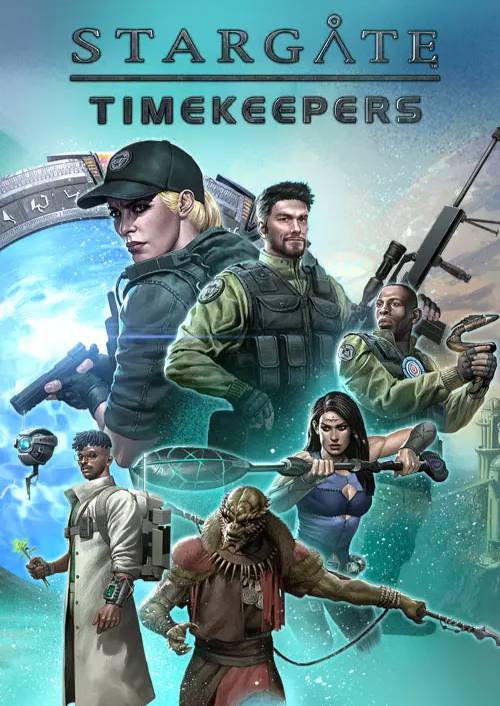
Stargate: Timekeepers
The official comeback, twenty years later
The first real Stargate game in years, and the most ambitious on the story side. You lead a team of specialists through an all-new campaign in the middle of the war against the Goa'uld, with stealth, plans to prepare and a time-loop plot. Released in two parts in 2024.
Year
2024
Genre
Real-time tactics
Studio
CreativeForge Games · Slitherine
Platforms
PC (Steam, GOG)
Metacritic score
72 / 100
Overview: the Stargate game nobody expected anymore
You have to appreciate what Stargate: Timekeepers represents before you even start the first mission. For years, the Stargate stayed shut for gamers. No new official game, a handful of projects gone up in smoke, and a community starting to believe the franchise would never return to our screens except in reruns. Then, in May 2021, Polish studio CreativeForge Games dropped the news: its mysterious "Project X" was a Stargate game, developed under an official MGM license and published by Slitherine and Matrix Games, respected specialists in PC strategy.
What makes Timekeepers special is its genre. It isn't a shooter or an MMO, but a real-time tactics game with a heavy dose of stealth, in the direct line of Commandos, Shadow Tactics and Desperados. Slitherine even billed it as the very first strategy game ever based on Stargate SG-1. You don't control SG-1; you lead an all-new team of specialists, moving them through the shadows to take down Jaffa without ever raising the alarm. Released on Windows, the game runs on the Unity engine and is single-player only, through a story campaign designed like a season of TV.
Development: two studios, one gate, and a lot of patience
The story of how the game was made is almost as eventful as its plot. CreativeForge Games, a Poland-based studio already known for Hard West and Ancient Space, announced the project in 2021 and showed its first gameplay footage that December. On paper, the game was expected in 2022. In practice, fans had to wait much longer, as release windows slipped while development dragged on.
In the meantime, a quiet but important industry move took place: Slitherine and CreativeForge grew close enough to found a studio together in Warsaw, keeping most of the original team. That's why, depending on the source, you'll see either CreativeForge Games or Slitherine Poland credited as developer, one being in fact the continuation of the other. That continuity explains how consistent the final product is despite years in the making.
The most striking choice was the two-part release. Slitherine split its "Season One" into two parts of seven missions each. Part One arrived on January 23, 2024, and Part Two on October 23, 2024, bringing the campaign to fourteen missions in all. A nice touch for players: the second part was free for everyone who already owned the first, with the new episodes unlocking automatically in the game, while newcomers paid around $29.99 for the whole thing.
Gameplay: stealth as a religion
Timekeepers fully embraces its heritage. You control a small squad with complementary skills, and each mission is a sprawling puzzle where observation beats action. You study guard patrols and their lines of sight, plan the order of takedowns, then execute the plan, ideally before a single enemy has time to understand what's happening. Because here, being spotted has a price: as soon as an enemy sees you, they call for backup, and a situation under control can turn into chaos in seconds.
The depth comes from the variety of characters. Each one adds a unique tool to the tactical kit. Colonel Eva McCain leads the team in combat, Max Bolton covers positions with his sniper rifle, scientist Derrick Harper tinkers with and repurposes technology, and Sam Watson, the spy, can disguise herself as a Jaffa to blend into enemy ranks and open the way. They're joined by A'ta, a Jaffa defector who knows the enemy forces from the inside. Part Two expands the roster further with Xugga, a veteran Unas as powerful as he is placid, who arrives with his little companion and new gameplay options.
The result is a demanding game that rewards careful reading of each situation and smart trial and error. It's also a game that, according to the press, stays safely within the genre's boundaries without reinventing the formula. Real-time tactics fans will feel right at home, even if they may wish it pushed its mechanics further than its illustrious models.
The story and its ties to the saga: a loop in time
The story is probably where Timekeepers speaks most to fans. The game doesn't settle for a generic Stargate backdrop: it slots precisely into the show's timeline, starting at the end of Stargate SG-1's seventh season. The campaign opens during the Battle of Antarctica, that pivotal moment when Anubis's fleet threatens Earth and SG-1 holds the planet's fate in its hands. Eva McCain's team is there in support, in the shadow of the great clash fans know by heart.
From that anchor point, the story branches into an entirely original adventure. Facing a new power-hungry Goa'uld System Lord named Dolus, the team finds itself trapped in a time loop. The whole challenge becomes understanding the trap, figuring out how it works, and turning time to their advantage to reverse the situation. That's where the title makes sense: the "timekeepers" literally have to master a repetition that only they are aware of.
It's a clever choice. It lets the developers tell their own story, with their own heroes, without ever rewriting canon or stepping on SG-1's toes. Fans get the familiar mythology, the Jaffa, the Goa'uld, the vocabulary of the saga, while meeting new faces. Still, critics often balked here: the dizzying potential of the Stargate universe and of the time-loop mechanic seems underused, as if the game didn't dare follow its own ideas all the way.
Reception: solid, honest, a little timid
On release, Timekeepers earned a Metacritic average of 72 out of 100, a reception described as mixed to average. Notably, there wasn't a single truly negative review: the press split between positive and measured verdicts, without ever tearing the game apart. Among the enthusiasts, The Games Machine called it a must-buy for fans of stealth tactics with a score of 82, while IGN, around 80, said it would happily step through the Stargate again and compared the game to Shadow Tactics.
The more reserved voices all point to roughly the same flaw. The core gameplay is solid, the stealth works, and the trickiest levels deliver real tactical satisfaction, but the game struggles to bring its writing to life. Several Italian outlets such as SpazioGames and Everyeye praised the interesting stealth tactics while regretting an underused license. GameStar was harsher still, arguing the game only holds up against the competition thanks to the Stargate name. The most common verdict: an honest, competent Commandos clone that comes close to very good without ever getting there, and that will mostly win over fans who were sold from the start.
In short, Timekeepers didn't win everyone over, but it didn't disappoint either. It delivered exactly what it promised: a clean tactics game, respectful of its license, no more and no less. For a franchise that hadn't released anything in a long time, that was already a kind of victory.
Its legacy: a battered franchise's comeback
To grasp the real value of Timekeepers, you have to remember the graveyard of projects that came before it. Stargate was long a cursed franchise when it came to video games. The most painful example remains Stargate Worlds, the ambitious MMORPG developed by Cheyenne Mountain Entertainment with the blessing of the show's producers, including Brad Wright as creative consultant. Slowed by the financial crisis of the late 2000s, the studio eventually filed for bankruptcy in February 2010, taking the game down with it, amid a financial scandal involving its executives.
Before that came Stargate SG-1: The Alliance, a shooter planned for Xbox, PlayStation 2 and PC, in which you would have played the four original members of SG-1. Developer Perception, in a dispute with its publisher JoWooD, saw the project collapse around 2005 and 2006 for lack of a deal with a new publisher, followed by a long legal battle. Between those shipwrecks, only a few minor titles and the online game Stargate: Resistance saw the light of day, without leaving much of a mark.
That's the context in which Timekeepers stands out. It's the first official strategy game in the universe, one of the rare Stargate projects to actually make it to the finish line, and above all a sign that the license could still live on in playable form. Modest in its ambitions, but very real in players' hands, it's worth as much for what it offers as for what it symbolizes: a gate finally reopened.
Trivia and curiosities
The name of the lead studio, CreativeForge Games, hides a small irony for fans: before diving into Goa'uld mythology, the Polish team had already tackled science fiction and turn-based tactics in its earlier productions, ideal training for handling a squad in the shadows.
The long development schedule is a story in itself. Announced in 2021 with gameplay footage by the end of that year, hoped for in 2022, then announced for summer 2023 by its publisher for a while, the game finally arrived only in January 2024. Between the announcement and the complete release of Season One in October 2024, more than three years went by, proof that making a Stargate game that actually ships can be quite a feat.
One last nod for connoisseurs: the time loop at the heart of the plot echoes one of SG-1's best-loved episodes, the one where the team relives the same day over and over. Timekeepers takes that idea so dear to the saga and makes it the engine of its entire campaign, like a playable tribute to what Stargate does best: turning a science fiction concept into a playground.
Stargate Initiative's take
Stargate: Timekeepers won't go down in history as a tactics masterpiece, and its 72 on Metacritic tells the truth fairly well: it's a good game, clean and honest, never great. But at Stargate Initiative, we refuse to judge it as just another Commandos clone. After years of closed gates and scuttled projects, finally holding an official game that respects the timeline and lets us relive the Battle of Antarctica alongside SG-1 is priceless for a fan. Our only regret is that it didn't dare make full use of its time loop and the wildness of its universe. A game to love for what it is and what it stands for, more than for what it could have been. Signed: Stargate Initiative.